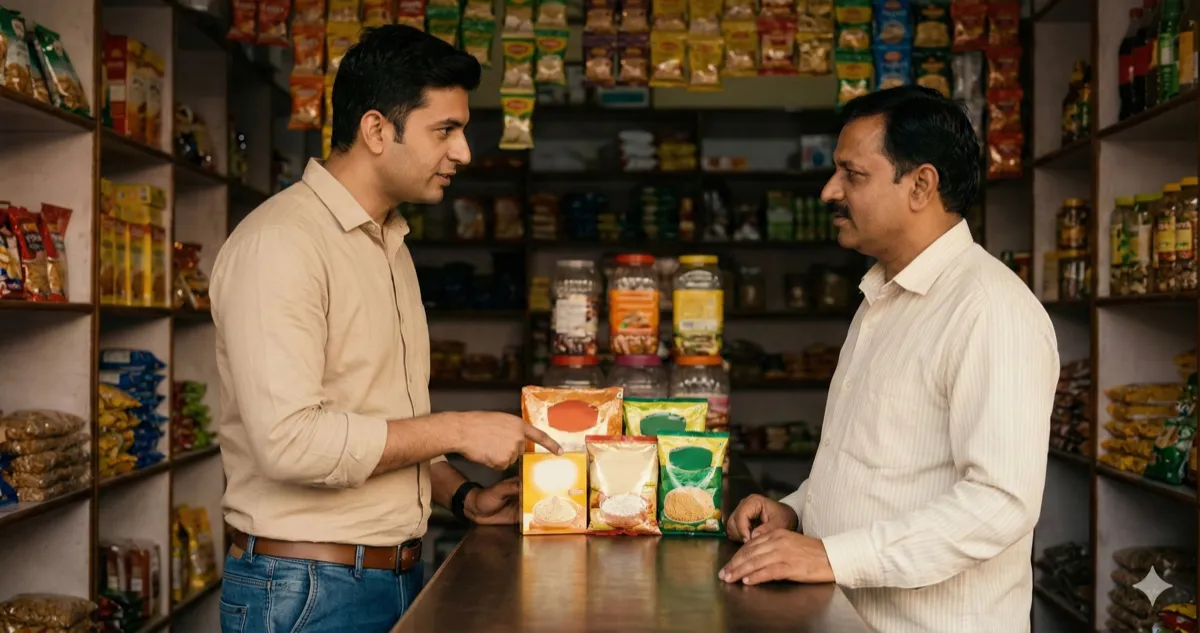
Finding and appointing distributors is one of the most consequential decisions a regional FMCG brand makes when entering a new state. Get it right, and the distributor becomes your market-building partner. Get it wrong, and you lose 6–12 months, burn working capital, and — worst of all — damage your brand's reputation with retailers before you've even started.
Most brands rush this step. They attend a trade show, get introduced to someone who “has godowns and vehicles,” sign a term sheet, and ship stock. Three months later, secondary sales are flat, the distributor is sitting on inventory, and the relationship is already souring.
This article is a practical guide to finding, evaluating, and appointing distributors the right way — especially when you're entering a state where you have no existing network. For the full picture of how general trade distribution works in India, start with our Complete Guide to FMCG Distribution in India.
Before You Call a Single Distributor: Define What You Actually Need
Before you start looking for distributors, answer these four questions clearly:
- What territory are you targeting? A city? A district? A full state? Your answer determines the type of distributor you need. A single-city distributor with 500 outlets is very different from a state-level operator with a godown network.
- What is your expected monthly secondary (retail) billing? If you expect ₹3–5 Lakhs/month in secondary sales in the first 6 months, you need a distributor who will care about that number. A large distributor doing ₹2 Cr/month in total billing will treat your brand as a rounding error.
- How many SKUs are you launching with? A focused portfolio (5–10 SKUs) is easier for a distributor to push. If you're launching with 40 SKUs across multiple sub-categories, you need a distributor with the right retail relationships and salesforce bandwidth.
- What credit terms can you offer — and what will you demand? Be honest about your working capital constraints. If you need payment in 15 days and the market norm is 30, you'll struggle to attract mid-tier distributors.
Where to Find Distributor Candidates
Once you know what you need, here's where to look:
- Industry associations and trade shows: Events like AAHAR, India Food Forum, and state-level FMCG expos are common hunting grounds. Associations like the All India Food Processors' Association (AIFPA) maintain directories.
- Existing retailers in the target market: Walk into 20–30 kirana stores in the target city and ask: “Who distributes [competitor brand] here?” Retailers know the active distributors, their reliability, and their coverage.
- Your existing distributor's network: A good distributor in State A often knows counterparts in State B. Ask for warm introductions.
- Kirana community platforms: Platforms that connect FMCG brands with retailers — like Kirana Club — can surface distributor interest from specific geographies without cold outreach.
- Super stockists and carrying & forwarding agents (C&FAs): If you're appointing through the traditional channel, your C&FA or super stockist in the region will usually have a shortlist of distributors they already work with for other brands.
How to Evaluate a Distributor: What to Ask, What to Verify
Never appoint a distributor based on a single meeting. Here are six dimensions to evaluate:
- Retail coverage: How many outlets does the distributor actively service? Ask for a beat plan, not just a number. “I cover 2,000 outlets” means nothing if their salesman visits 50 per day across a massive territory with no depth.
- Category fit: Does the distributor already carry brands in your category or an adjacent one? A distributor strong in home care may not be the right partner for packaged food, even if they have great retail relationships.
- Infrastructure: Visit the godown. Check for adequate storage, cold chain (if needed), and vehicle availability. A distributor who relies entirely on third-party transport will have delivery reliability issues.
- Salesforce strength: How many dedicated salesmen does the distributor employ? Are they on payroll or contract? How many brands do they push on each beat? If the salesman is already pushing 15 brands, your brand will get 2 minutes per outlet.
- Financial health: Can the distributor handle your expected billing without straining? Ask about existing credit exposure, payment track record with other brands, and willingness to invest in initial market development.
- Reputation with retailers: This is the most important and most often skipped check. Visit 10 retailers the distributor claims to service and ask: “How is their delivery? Do they handle returns well? Do they push expired stock?” A distributor's relationship with retailers is your brand's relationship with the market.
Sell directly to 40L+ kiranas — no GT network needed. Launch on Kirana Club's D2R Marketplace.
Explore the Marketplace →Distributor Terms: What to Define Clearly
The distributor terms sheet is where most problems start — because most brands leave critical terms vague. Here is what must be defined upfront:
| Term | What to Define |
|---|---|
| Territory | Exact geography — pin codes, districts, or city zones. Never leave it as “State XYZ.” |
| Exclusivity | Is the distributor exclusive for the territory? For how long? Under what performance conditions? |
| Credit days | Payment cycle — 7, 15, 21, or 30 days. Include penalty for overdue. |
| MOQ | Minimum order quantity per month. Tie it to a minimum secondary sales target. |
| Returns/expiry | Who bears the cost of expired or damaged goods? Define the claim process and timelines. |
| Scheme responsibility | Who funds trade schemes — brand, distributor, or shared? How are schemes communicated to retailers? |
| Secondary data sharing | Must the distributor share outlet-level secondary sales data? How frequently? In what format? |
| Exit clause | Under what conditions can either party exit? What happens to unsold stock? Define the notice period. |
For a complete template and red flags to watch for, read our Distributor Terms Sheet and Red Flags article.
Run a Pilot Before Giving Exclusivity
The single biggest mistake brands make is granting exclusive territorial rights on day one. Instead, run a 90-day pilot:
- Ship a limited initial order (₹1–3 Lakhs worth of stock).
- Set clear targets: number of outlets billed, secondary sales value, and retailer feedback.
- Have your area sales manager (or you, if you're the founder) visit the market at least twice during the pilot to verify ground reality.
- At the end of 90 days, evaluate honestly. If the distributor has met 70%+ of the agreed targets, formalize the relationship. If not, have a candid conversation and either course-correct or exit.
A pilot protects both sides. It protects the brand from committing to an underperforming partner, and it protects the distributor from over-investing in a brand that hasn't proven local demand. For more on this approach, see How to Test a New Market Before Full Expansion.
The Three Signals That a Distributor Is Underdelivering
Even after a successful pilot, monitor these warning signs:
- Declining unique outlet billing: The distributor is billing fewer unique outlets month-over-month. This means they're either losing retail relationships or concentrating sales in a few large outlets — both are problems.
- Rising claims and disputes: If the distributor's damage, return, and scheme claims are growing faster than sales, something is off. Either the product isn't moving (and they're passing the cost back to you), or they're gaming the claims process.
- No secondary data transparency: A distributor who won't share outlet-level secondary data is either hiding poor performance or doesn't have the systems to track it. Either way, you're flying blind. For more on managing credit and collections with distributors, read Credit Risk and Collections in GT.
Sell directly to 40L+ kiranas — no GT network needed. Launch on Kirana Club's D2R Marketplace.
Explore the Marketplace →The Honest Truth About Traditional Distribution
For brands expanding beyond their home state, the traditional distributor appointment model works — but it's slow, capital-intensive, and difficult to scale without a large field team.
- Finding and appointing one good distributor in a new state takes 2–4 months.
- Building meaningful secondary sales takes another 3–6 months.
- Scaling to full state coverage typically requires 3–5 distributors, each needing management and support.
This is why many brands are now supplementing their traditional distribution with D2R (Direct-to-Retailer) platforms that allow them to reach kiranas directly, test demand, and build a retail base before committing to full distribution infrastructure. It's not a replacement for distributors — it's a way to enter faster and smarter.
For the full picture of how FMCG distribution works in India — and where it's headed — read our Complete Guide to FMCG Distribution in India.