Getting pricing right is the foundational work of GT expansion. Everything else — distributor performance, retailer adoption, secondary sales — is influenced by whether your pricing architecture makes sense for the market you're entering.
The Vocabulary: What Each Term Means
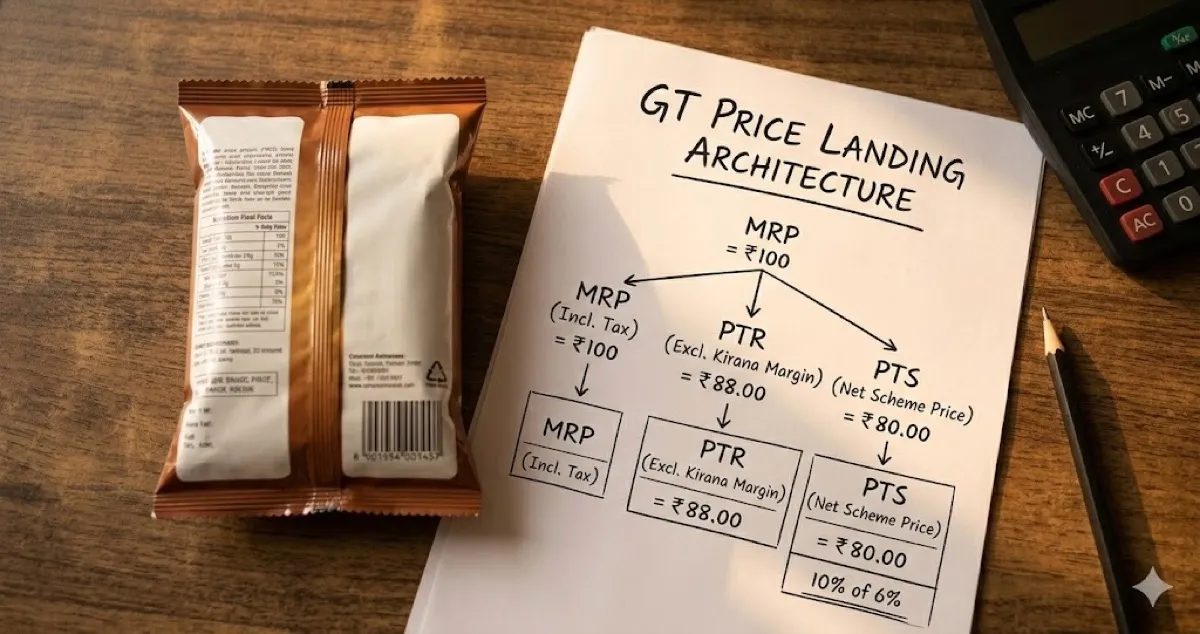
MRP (Maximum Retail Price): The price printed on the pack. The consumer pays this.
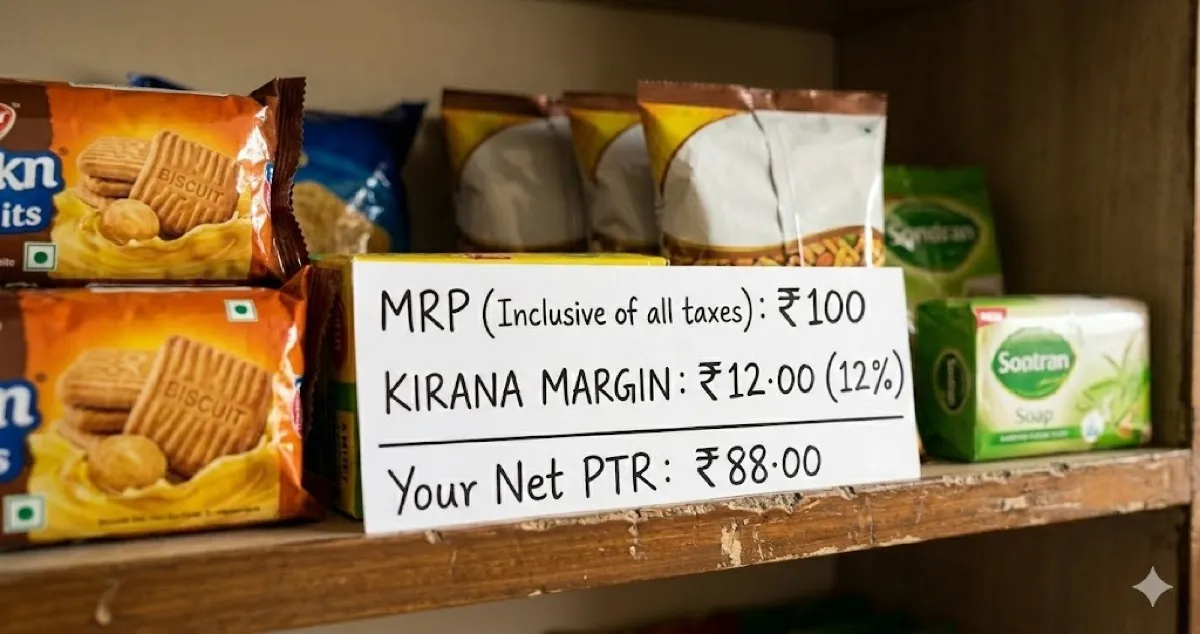
PTR (Price to Retailer): What the distributor sells to the retailer. PTR is typically MRP × (1 - retailer margin%). If your retailer margin is 20% and MRP is ₹100, PTR is ₹80.
PTS (Price to Stockist/Distributor): What you sell to the distributor. PTS is PTR × (1 - distributor margin%). If distributor margin is 6% and PTR is ₹80, PTS is ₹75.20.
Scheme Price: The effective price after applying trade schemes (free goods, discounts). This is what distributors calculate when deciding whether your brand is worth handling.
The entire pricing architecture flows from MRP down. If your MRP is set wrong for the new state, everything below it breaks.
Why the Same MRP Often Fails in a New State
A brand that has been selling at ₹30 MRP for a pack in Rajasthan tries to enter Karnataka at the same MRP. What breaks:
Freight adds real cost: Factory in Jaipur to Bengaluru adds perhaps 3–4% in freight. If you absorb this in your margin, your contribution drops. If you pass it to the distributor, they lose margin and prioritize other brands.
Competitive MRPs are different: In Karnataka, there may be a local brand selling the same product at ₹25. Your ₹30 MRP requires a reason to exist (brand preference, quality, packaging). If that reason isn't there yet, you'll lose retailer push.
Category positioning differs: A mid-market brand in a category may be “premium” in one state and “economy” in another. The target segment's willingness to pay differs.
Resolution options:
- Regional MRP (different MRP for different states — legal and common in FMCG)
- Different pack sizes for different states (₹10 pack in high-price states, ₹5 pack elsewhere)
- Adjust your margin expectations for the new state and design a separate P&L
For a detailed breakdown of distributor and retailer margins, see our guide on FMCG distributor and kirana margins.
How to Build PTR/PTS for a New State
Step 1: Research competitive MRPs in the target market. What are equivalent products selling for? What is the trade's mental benchmark for your category?
Step 2: Decide your MRP. If you're entering at the same or similar MRP as competition, you need better retailer margins. If you're premium-priced, you need consumer pull to justify it.
Step 3: Work backwards from retailer margin:
- Assess retailer margin required for your brand pull level
- PTR = MRP × (1 - retailer margin %)
Step 4: Assess distributor margin and logistics:
- Add incremental freight for the new state
- Decide distributor margin
- PTS = PTR × (1 - distributor margin %) - incremental freight
Step 5: Calculate your contribution:
- Net realization = PTS - factory cost - your own logistics to state
- If contribution is below 20%, your pricing model is not viable for long-term operation
Sell directly to 40L+ kiranas — no GT network needed. Launch on Kirana Club's D2R Marketplace.
Explore the Marketplace →Schemes: Design Them for Specific Objectives
Every scheme should have a clear, time-bound objective. Schemes without objectives become pricing.
Trial scheme (first 90 days): Objective is retailer adoption. “Buy 5 cases, get 1 free” brings effective PTR down. This is the cost of entry, not steady-state margin.
Velocity scheme: Objective is increasing order frequency. “Reorder within 10 days, get additional 3% discount.” Creates urgency for restocking.
Visibility scheme: Objective is shelf placement. “Counter display unit with every 10-case order.” You're paying for visibility with goods, not cash.
SKU introduction scheme: Objective is listing a new SKU alongside existing. “Add 2 cases of New SKU X with any order above ₹5,000, get it at 25% off.” Risk-reduction for the retailer on the new SKU.
Warning: When any scheme runs for more than 3 consecutive months, the trade starts treating the scheme price as the real PTR. If you then try to withdraw the scheme, you face resistance as though you're actually raising price. Run schemes in defined windows with defined end dates.
The Multi-Pack Strategy for New State Entry
Many brands underuse this: launching a smaller pack size specifically for new market entry.
A ₹5 or ₹10 impulse pack in a new state does multiple things:
- Consumer trial risk is near-zero (consumer doesn't lose much if they don't like it)
- Retailer first-order risk is low (small cash commitment)
- Pack rotation is faster (high-velocity small packs build sell-through data faster)
- If the brand builds consumer pull at the small pack, the medium/large packs follow naturally
The small pack is not a permanent strategy — margins are typically tighter. It's a market entry mechanism.
For the complete framework on FMCG distribution in India, read our comprehensive distribution guide. For insights on how kiranas decide which products to stock, see how kirana stores decide what to stock.