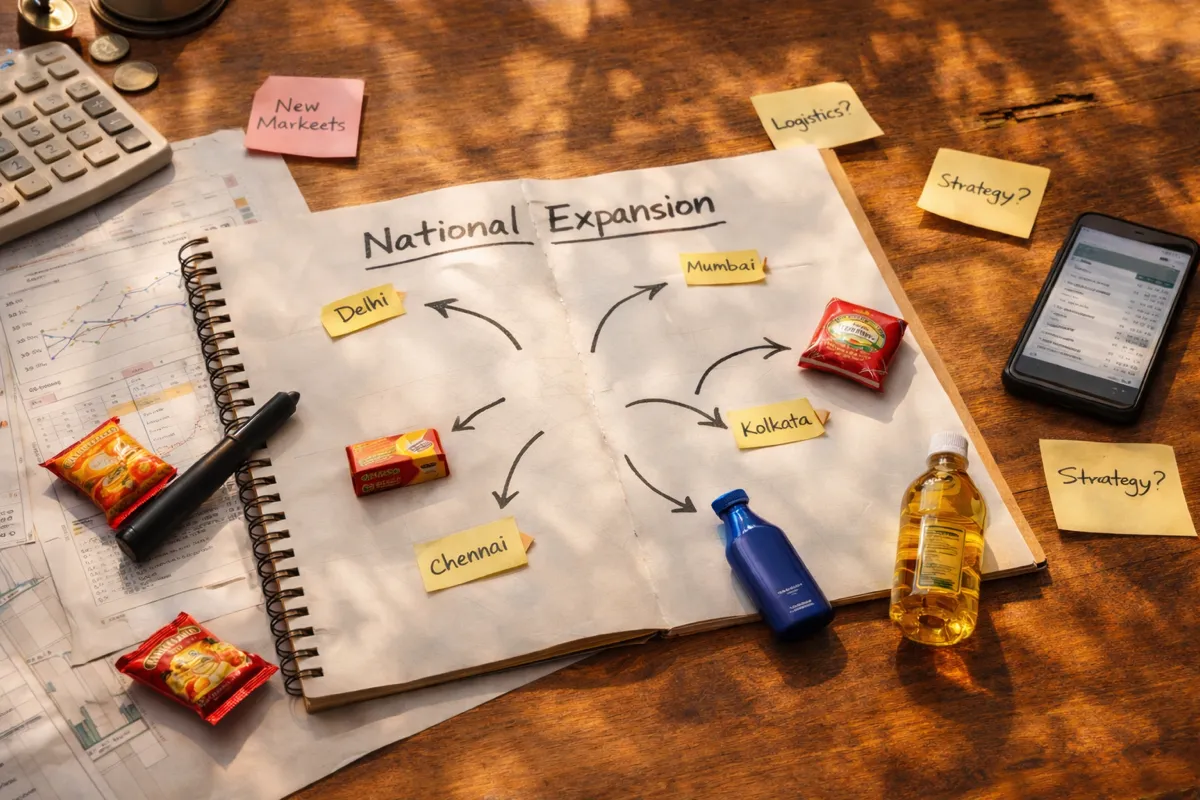
The honest truth about going national: it is not one expansion. It is a sequence of 15–20 individual market entries, each with their own economics, competitive landscape, and consumer behavior. Brands that treat it as one big initiative usually fail. Brands that treat it as a series of repeatable, learnable experiments have a much better track record.
Phase 1: Get Your Home Base Right Before You Leave
The temptation is to escape the ceiling at home by going national. That's a mistake if home isn't truly strong.
Before entering any new state, validate:
Unit economics clarity: Do you know your actual all-in contribution margin at the current state level? Not just “we sell at X MRP and buy from factory at Y.” All-in — distribution cost, returns, schemes, team, working capital cost.
Operational repeatability: Is your manufacturing reliable enough to support multiple states simultaneously? Can your current 3PL or logistics setup scale to a new lane?
SKU portfolio strength: Do you have 5–8 SKUs with proven consumer repeat? Or are you running on 1–2 strong products and a long tail of slow movers?
Data infrastructure: Do you have weekly secondary data from your home state? If you can't see secondary in your home market, you can't run a new market entry — you'll have no benchmark to compare against.
Phase 2: First Expansion — Adjacent States, Not Dream Markets
The first state you enter should not be your ambition state. It should be the state where your odds of success are highest.
What makes a good first expansion state:
Cultural/consumption proximity to home state — A brand from Rajasthan should consider Gujarat, Madhya Pradesh, or western Maharashtra before considering Bengal or Tamil Nadu. Similar food habits, similar language affinity, some brand name recognition via cross-border shopping.
Strong logistics lane — You need to be able to serve this state reliably. If your factory is in Jaipur, Delhi-NCR and Rajasthan's border states have better freight economics than Northeast India.
Competition density — Entering a state dominated by one very entrenched local FMCG brand with home-ground advantage is a harder battle. A state with fragmented competition gives you more room.
Distributor quality — In some states, the distributor ecosystem for your category is well-developed. In others, finding a credible distributor is itself a 3-month project.
For guidance on finding the right distribution partners, see our guide on how to find distributors in India.
Phase 3: The 90-Day Entry Protocol (Repeatable for Each State)
Every new state entry should follow the same protocol:
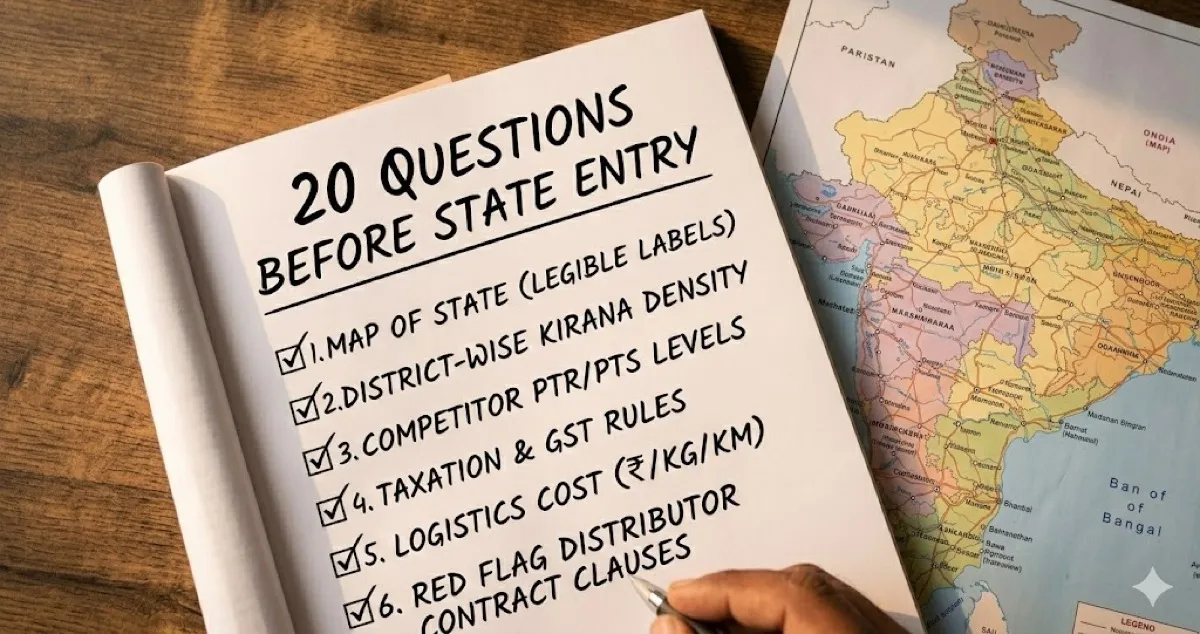
Weeks 1–4: Market research and city selection. Who are the dominant distributors in your category in target cities? What's the competitive pricing? What retailer margin is the norm?
Weeks 5–8: Pilot launch in 2 cities, 5–8 SKUs. Low MOV, attractive trial margin, predictable delivery. Measure retailer activation.
Weeks 9–16: Reorder analysis. What's coming back? Which SKUs? Which cities? What feedback from retailers?
Weeks 17–24: Decision point. If reorder rate validates the market, build the infrastructure: appoint a state head, formalize distributor relationships, expand city count. If it doesn't, diagnose and iterate before committing.
The 90-day protocol burns less capital than a full commitment entry and gives you data to make the scale decision with confidence instead of hope.
For a deeper dive into the market testing framework, read our guide on how to test a new FMCG market.
Sell directly to 40L+ kiranas — no GT network needed. Launch on Kirana Club's D2R Marketplace.
Explore the Marketplace →Phase 4: Build the Organization to Support Multiple States
Many brands enter 5 states in 18 months and then discover they don't have the organizational bandwidth to actually manage them well. Signs of this:
- The founder is the de facto state head for every state because there's no layer below
- Secondary data is collected informally and inconsistently across states
- Scheme design varies by state because there's no central trade marketing function
- Distributor relationships vary wildly in quality because there's no standard evaluation process
The organizational build for a ₹100–300 Cr brand that wants to be truly national:
- A VP/Head of Sales with national GT experience (not just regional)
- State heads or ASMs per state who own P&L accountability, not just target
- A central trade marketing function that designs schemes consistently
- A weekly secondary data review process (not quarterly)
- A supply chain team that can handle multi-state demand variability
The org build typically needs to precede the revenue by 12–18 months. If you hire the org after you've entered 8 states, you're managing chaos, not distribution.
Phase 5: The Metrics That Tell You It's Working
National expansion is working when:
By state level: Active outlet count growing, reorder rate above 45%, expiry/damage returns below 3%, distributor payment cycle within agreed terms.
By SKU level: 5–8 hero SKUs showing consistent sell-through across states, no single SKU accounting for more than 35% of primary.
By financial metrics: State-level contribution margin positive by month 9–12. Working capital cycle stabilizing. Scheme spend declining as a % of primary as brand pull builds.
The lagging indicator that matters most: Are consumers in new states asking for your brand by name? That's the shift from push-distribution to pull-brand. Most regional brands get to national distribution without ever fully making this transition. The ones that do become genuinely national FMCG companies.
For the complete framework on FMCG distribution in India, read our comprehensive distribution guide. For a tactical checklist to use during each state entry, see our FMCG state expansion checklist.