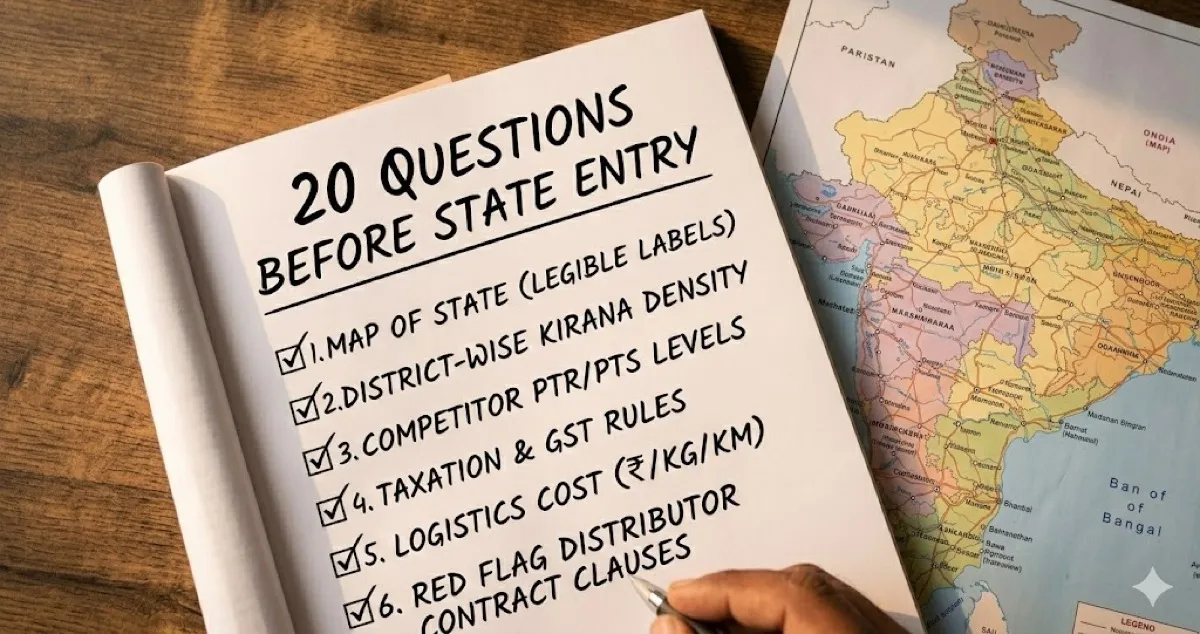
Use this before you spend money on a new state. Each question has a wrong answer and a right answer — be honest with yourself.
Category A: Market Understanding
Wrong answer: “We're entering the state.”
Right answer: City-specific logic based on demand data, logistics feasibility, and competitive assessment.
Wrong answer: “It's not a very competitive market.”
Right answer: Named competitors, their shelf prices, their approximate retailer margins, and their distribution depth.
Wrong answer: Assumed yes without research.
Right answer: Validated via retailer visits or trade research in the target city.
This matters for scheme communication, WhatsApp outreach, and on-ground activation.
Learn how to test a new FMCG market before committing fully.
Category B: Product and Pricing Readiness
Right answer: Your highest repeat-velocity products from home state, packaged suitably for this state's consumption patterns.
Wrong answer: Same PTR/PTS as home state.
Right answer: Fresh calculation with freight differential, realistic retailer margin, and contribution check. See our guide on GT pricing architecture (MRP, PTR, PTS).
Right answer: Benchmarked against actual field research, not assumption. Read more about FMCG distributor and kirana margins.
Wrong answer: “We'll run good offers.”
Right answer: Specific scheme design with defined end date and clear objective (trial vs. velocity vs. visibility).
Right answer: A contribution margin calculation at steady-state PTR/PTS showing positive territory. Understand the full cost of GT distribution in a new state.
Sell directly to 40L+ kiranas — no GT network needed. Launch on Kirana Club's D2R Marketplace.
Explore the Marketplace →Category C: Operational Readiness
Wrong answer: “Our logistics team said yes.”
Right answer: You've run 10 test shipments to the target cities and validated the 3PL's TAT and damage rate. See our guide on GT logistics and fulfillment for kiranas.
Right answer: Known, based on actual data from similar distance shipments.
Right answer: Set based on what a kirana needs to commit to feel low-risk, not based on what's convenient for your logistics.
Wrong answer: “We'll handle it case by case.”
Right answer: Written policy with time windows, documentation requirements, and resolution SLAs. Read about FMCG returns, expiry, and damages in GT.
Right answer: Yes, with a defined process for monitoring aging inventory at distributor level.
Category D: Channel and Partner Readiness
Right answer: Beat plan reviewed, sample retailer list obtained, reference check with another brand principal done. Learn how to find distributors in India.
Wrong answer: Full appointment with state exclusivity from day one.
Right answer: Pilot structure with outlet count and secondary targets that unlock exclusivity. Use our FMCG distributor terms sheet as a starting point.
Right answer: Defined upfront, in writing. See our guide on credit risk and collections in GT.
Right answer: Weekly outlet-wise, SKU-wise. Defined as a requirement, tied to scheme reimbursement.
Sell directly to 40L+ kiranas — no GT network needed. Launch on Kirana Club's D2R Marketplace.
Explore the Marketplace →Category E: Success Definition and Exit Criteria
Wrong answer: “Good growth.”
Right answer: Specific numbers — active outlet count, reorder rate threshold, revenue run rate, claim/return rate ceiling.
Wrong answer: “We'll see.”
Right answer: A defined decision tree: investigate and iterate, shift to a different distributor, exit the city, or conclude the market isn't right for this SKU set.
This checklist should take you 2–3 hours to complete properly. If you can't answer more than 5–6 questions with specific, data-backed answers, you're not ready to enter the state — you're ready to do more research first.
For the complete distribution strategy framework, see our complete guide to FMCG distribution in India. Also read our regional to pan-India FMCG playbook for the broader expansion perspective.